

Dr Sayed Salman Safavi
London Academy of Iranian Studies (LAIS)
Abstract
In Quranic culture, supplication (duʿāʾ) constitutes a conscious, living, dynamic, and multi-layered communicative event between humanity and the Divine. Utilising a semiotic framework, this article analyses supplication as a primary “channel” (medium) of spiritual communication, elucidating the relationship between exterior etiquette (linguistic and behavioural practices) and the interior realm (spiritual states and heart-cantered presence). The research demonstrates that the etiquettes of supplication are not scattered, purely ritualistic prescriptions, but rather functional components that refine the message, deepen internal presence (ḥuḍūr al-qalb), and align the moral and behavioural orientation of the supplicant during dialogue with the Absolute Reality.
Keywords: Duʿāʾ (Supplication), Quranic Semiotics, Adab al-Duʿāʾ (Etiquette of Supplication), Spiritual Communication, Seyed Salman Safavi.
1. Introduction: Semiotic Analysis of Supplication and Components of Spiritual Communication
From a broad semiotic perspective, supplication (duʿāʾ) can be understood as the primary “channel” (medium) of a conscious, living, and dynamic communication between human beings and God. Within this theoretical framework, the channel represents the path, medium, and semiotic substrate through which servitude, sincerity, existential need, and orientation toward the Absolute Self-Sufficient (al-Ghanī) are expressed.
This communicative process and semantic encoding operate across two interdependent dimensions:
- The Exterior Dimension (Linguistic): The articulated words, formulas, the Divine Names (al-Asmāʾ al-Ḥusnā), blessings (ṣalawāt), and verbal constructs that form the linguistic expression and structure of the message.
- The Interior Dimension (Spiritual/Heart-Centered): Intent (niyyah), sincerity (ikhlāṣ), presence of heart, humility, and spiritual states that constitute the existential core and soul of the message.
A dynamic, reciprocal relationship exists between these two dimensions: the heart imparts life and authentic presence to the words, while reflective engagement with the words and adherence to exterior etiquette disciplines and prepares the heart. Supplication is thus both the manifestation of meaning and an active process of semantic formation and deepening within the soul of the supplicant.
This communicative event can be structurally situated from one angle as a ‘monologic address’ from the human being as the ‘sender’, articulating existential poverty in linguistic codes. However, in a deep-structure semiotic analysis, it functions as a dialogic process. The human supplicant addresses God as the ‘Absolute Receiver’ and ‘Ultimate Interpreter’; the Divine response manifests not necessarily in human speech, but through the reading of signs (semiotic reading), spiritual illuminations, inner peace, and existential transformations decoded within the deep structure of the supplicant’s soul. This process elevates the text of supplication from a simple verbal interaction to a ‘spiritual and communicative event’ characterised by the openness of semiosis and a plurality of meaning levels (Eco, 1979; Safavi, 2024).
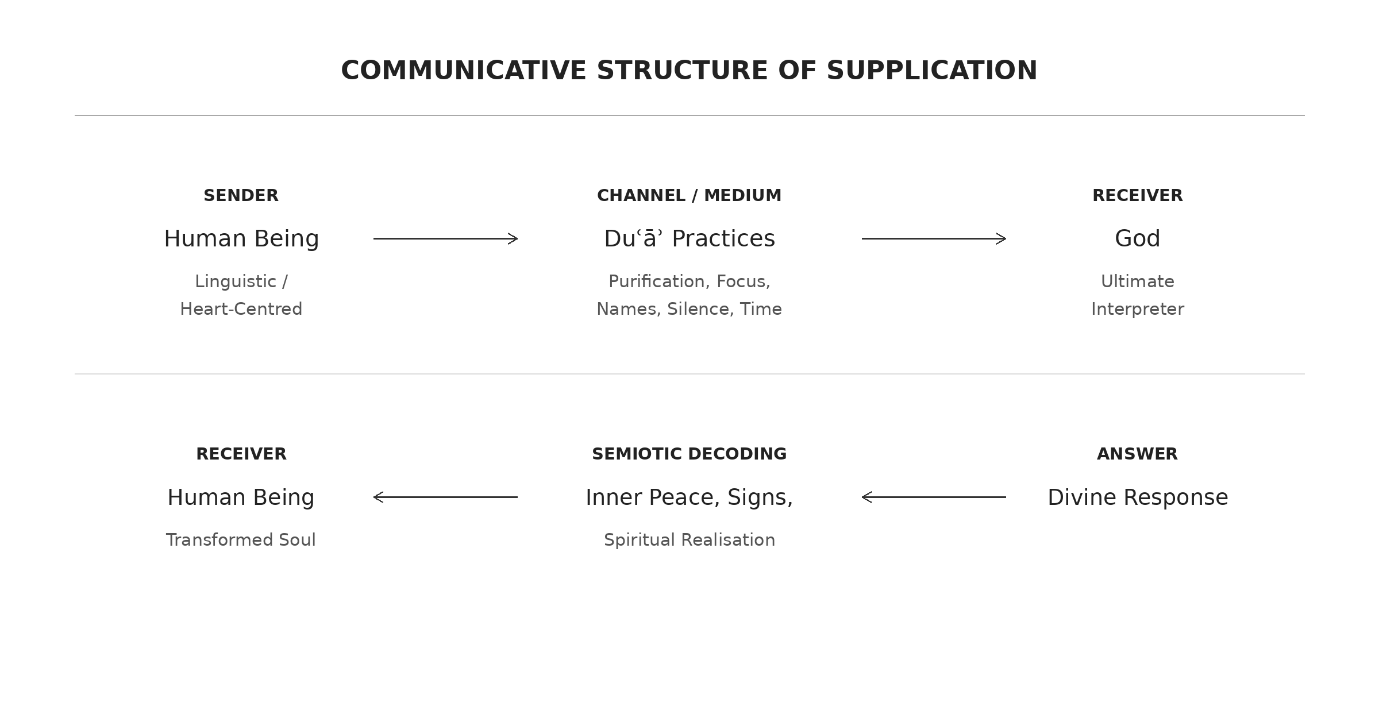
This communicative dynamic mirrors the structural vector of prophetic revelation (waḥy), wherein the Divine message originates from God (Sender) to the Prophet (Receiver) for human guidance. Supplication operates in the inverse structural direction—from human to God—while fully preserving the distinct ontological nature and authority of revelation versus supplication. The distinct innovation of this article lies in applying this semiotic approach to structure and explain how specific etiquettes (ādāb) organize the various elements of this spiritual channel.
2. Supplication in the Logic of the Quran
God Almighty states in the Quran:
وَقَالَ رَبُّكُمُ ادْعُونِي أَسْتَجِبْ لَكُمْ
“ And your Lord has said, “Call upon Me, and I shall respond to you.'” (Quran 40:60; Nasr et al., 2015)
Supplication is the conscious turning of the human being toward God, acknowledging one’s innate poverty before Divine Self-Sufficiency. It is an intimate dialogue with a Lord who is inherently near:
وَإِذَا سَأَلَكَ عِبَادِى عَنِّى فَإِنِّى قَرِيبٌ ۖ أُجِيبُ دَعْوَةَ ٱلدَّاعِ إِذَا دَعَانِ
“ When My servants ask thee about Me, truly I am near. I answer the call of the caller when he calls Me.“ (Quran 2:186)
In Qur’anic doctrine, supplication is intrinsically linked to faith, righteous action, and responding to the Divine call, as the verse continues:
فَلْيَسْتَجِيبُوا۟ لِى وَلْيُؤْمِنُوا۟ بِى لَعَلَّهُمْ يَرْشُدُونَ
“ So let them respond to Me and believe in Me, that they may be led aright.” (Quran 2:186)
Jalāl al-Dīn Rūmī captures this reciprocal spiritual reality in the Mathnawī:
یاد ده ما را سخنهای دقیق
که ترا رحم آورد آن، ای رفیق
هم دعا از تو، اجابت هم ز تو
ایمنی از تو، مَهابَت هم ز تو
“Teach us precise words
that move Thee to mercy, O Friend!
Both prayer and answer come from Thee;
safety and awe both originate from Thee.”
(Rumi, 2002, Book II, lines 692–693)
3. The Structural Role of Etiquettes in the Semiotic Framework
To understand how each etiquette functions within the communicative system between human and God, their structural roles are organised below:
| Category of Etiquette | Functional Role in Semiotic & Communicative Analysis |
| 1. Purity, Fragrance, Orientation & Silence | Establishes the receptive environmental substrate, eliminates noise, and focuses the channel. |
| 2. Forgiveness (Istighfār), Restitution & Charity | Clears the spiritual channel; anchors devotional speech in moral responsibility and ethical action. |
| 3. Presence of Heart, Sincerity & Humility | Deepens internal focus, shapes the interior dimension of the message, and establishes spiritual alignment. |
| 4. Bismillah, Praise, Ṣalawāt & Divine Names | Formulates the linguistic and semantic structure of the address; structures the message frame. |
| 5. Persistence, Patience & Intercession | Sustains the communicative stream; manifests existential humility. |
| 6. Silent Contemplation & Trust (Tawakkul) | Maintains receptive focus post-supplication; prepares the recipient to decode the Divine response. |
4. Detailed Explanation of the Etiquettes of Supplication
4.1. Repentance and Moral Rectification (Clearing the Channel)
The primary etiquette of supplication is returning to God (tawbah) and cleansing the heart from sin and unfulfilled rights (ḥuqūq al-nās). The Quran links seeking forgiveness (istighfār) directly with repentance:
وَأَنِ اسْتَغْفِرُوا رَبَّكُمْ ثُمَّ تُوبُوا إِلَيْهِ
“ And seek forgiveness from your Lord; then turn unto Him in repentance.” (Quran 11:3)
Adam and Eve initiated their repentance by acknowledging their fault:
رَبَّنَا ظَلَمْنَا أَنْفُسَنَا وَإِنْ لَمْ تَغْفِرْ لَنَا وَتَرْحَمْنَا لَنَكُونَنَّ مِنَ الْخَاسِرِينَ
“They said, ‘Our Lord! We have wronged ourselves. If Thou dost not forgive us and have Mercy upon us, we shall surely be among the losers.’” (Quran 7:23)
Repentance requires behavioural rectification and returning misallocated rights:
إِلَّا الَّذِينَ تَابُوا وَأَصْلَحُوا وَبَيَّنُوا
“Save such as repent, and make amends, and make clear.” (Quran 2:160)
إِنَّ اللَّهَ يَأْمُرُكُمْ أَنْ تُؤَدُّوا الْأَمَانَاتِ إِلَىٰ أَهْلِهَا
“God commands you to return trusts to their rightful owners.” (Quran 4:58)
Commander of the Faithful Imam ʿAlī ibn Abī Ṭālib (a) outlined the reality of true istighfār:
الِاسْتِغْفَارُ دَرَجَةُ الْعِلِّيِّينَ وَ هُوَ اسْمٌ وَاقِعٌ عَلَى سِتَّةِ مَعَانٍ: أَوَّلُهَا النَّدَمُ عَلَى مَا مَضَى، وَ الثَّانِي الْعَزْمُ عَلَى تَرْكِ الْعَوْدِ إِلَيْهِ أَبَداً، وَ الثَّالِثُ أَنْ تُؤَدِّيَ إِلَى الْمَخْلُوقِينَ حُقُوقَهُمْ…
“Seeking forgiveness is the station of the exalted ones. It rests upon six meanings: first, remorse over what has passed; second, the firm resolve never to return to it; third, discharging to created beings their rights…” (Sharīf al-Raḍī, 1980, Sayings 417)
4.2. Ritual Purity, Charity, Adornment, and Pre-Supplication Silence
- Ablution (Wuḍūʾ): Entering the sanctuary of prayer in a state of ritual purity.
- Charity (Ṣadaqah): Offering charity prior to supplication to invoke Divine mercy.
- Fragrance and Facing the Qiblah: External refinement and physical orientation toward the sanctuary.
- Quiet Reflection Before Supplication: Sitting in silence prior to prayer to settle the mind:
وَاذْكُرِ اسْمَ رَبِّكَ وَتَبَتَّلْ إِلَيْهِ تَبْتِيلًا
“So remember the Name of thy Lord and devote thyself to Him with complete devotion” (Quran 73:8)
4.3. Presence of Heart, Sincerity, and Humility (The Interior Dimension)
Supplication is not only a vocal exercise; heart-cantered awareness, devotion, and sincerity constitute its essence:
ادْعُوا رَبَّكُمْ تَضَرُّعًا وَخُفْيَةً إِنَّهُ لَا يُحِبُّ الْمُعْتَدِينَ
“Call upon your Lord humbly and in secret. Truly He loves not the transgressors.” (Quran 7:55)
وَادْعُوهُ خَوْفًا وَطَمَعًا
“Call upon Him in fear and in hope” (Quran 7:56)
فَادْعُوا اللَّهَ مُخْلِصِينَ لَهُ الدِّينَ
“So call upon God, devoting religion entirely to Him” (Quran 40:14)
Imam Jaʿfar al-Ṣādiq (a) stated:
اِنَّ الله لايَستَجيبُ دُعاء بِظَهر قَلب ساه فَاِذا دَعَوتَ فَاقبِل بِقَلبِک ثُمَّ استَيقن بِالاِجابَة
“Indeed, God does not answer a supplication emanating from a heedless heart. When you supplicate, turn with your heart, then be certain of the response.” (Majlisī, 1983, Vol. 90, p. 305)
ʿAṭṭār al-Nīshāpūrī expresses this internal dedication in Manṭiq al-Ṭayr:
من ترا خواهم، ترا دانم، ترا
هم تو جانم را و هم جانم ترا
حاجت من در همه عالم تویی
این جهانم و آن جهانم هم تویی
“Thee alone I seek, Thee alone I know, Thee alone!
Thou art for my soul, and my soul is for Thee.
My sole desire in all the universe is Thee;
Thou art my this-world and my Hereafter.” (Attar, 2004, p. 112)
4.4. The Bismillah, Praise, Ṣalawāt, and the Divine Names (The Linguistic Frame)
Beginning with the Bismillah: The Prophet (ṣ) said: «لَا یُرَدُّ دُعَاءٌ أَوَّلُهُ بِسْمِ اللَّهِ الرَّحْمنِ الرَّحِیمِ»—“A supplication that begins with ‘In the Name of God, the Compassionate, the Merciful’ is not rejected.” (Majlisī, 1983, Vol. 90, p. 313).
Praise (Ḥamd) and Salutations (Ṣalawāt): Sūrat al-Fātiḥah establishes the structural model of advancing praise («الْحَمْدُ لِلَّهِ رَبِّ الْعَالَمِينَ») before petition («اهْدِنَا الصِّرَاطَ الْمُسْتَقِيمَ»). The invocation of blessings upon the Prophet and his Progeny is explicitly commanded in the Quran:
إِنَّ اللَّهَ وَمَلَائِكَتَهُ يُصَلُّونَ عَلَى النَّبِيِّ يَا أَيُّهَا الَّذِينَ آمَنُوا صَلُّوا عَلَيْهِ وَسَلِّمُوا تَسْلِيمًا
“Truly God and His angels invoke blessings upon the Prophet. O you who believe! Invoke blessings upon him, and greetings of peace!.” (Quran 33:56)
Imam al-Ṣādiq (a) counselled that prayers framed between two ṣalawāt are accepted because God is too generous to accept the two ends of a prayer and leave the middle unanswered (Kulaynī, 1984, Vol. 2, p. 494). Concluding with «مَا شَاءَ اللَّهُ لَا قُوَّةَ إِلَّا بِاللَّهِ» (“As God wills! There is no power save in God”, Quran 18:39) is likewise recommended.
Invocation of the Most Beautiful Names (al-Asmāʾ al-Ḥusnā):
وَلِلَّهِ الْأَسْمَاءُ الْحُسْنَىٰ فَادْعُوهُ بِهَا
“Unto God belong the Most Beautiful Names; so call Him by them” (Quran 7:180)
The supplicant selects Divine Names corresponding to their petition: al-Razzāq (The Sustainer) for sustenance, or al-ʿAlīm (The All-Knowing) and al-Ḥakīm (The Wise) for knowledge and wisdom.
4.5. Persistence, Altruism, and Existential Humility
Intercession and Praying for Others: Prioritizing fellow believers in supplication:
رَبَّنَا اغْفِرْ لَنَا وَلِإِخْوَانِنَا الَّذِينَ سَبَقُونَا بِالْإِيمَانِ
“Our Lord! Forgive us and our brothers who preceded us in faith.” (Quran 59:10)
Humility and Awe: Raising hands toward the heavens, weeping or inducing tears (tabākī), and invoking verses signifying Divine Proximity:
«وَنَحْنُ أَقْرَبُ إِلَيْهِ مِنْ حَبْلِ الْوَرِيدِ» — “And We are nearer to him than his jugular vein.” (Quran 50:16)
«أَنَّ اللَّهَ يَحُولُ بَيْنَ الْمَرْءِ وَقَلْبِهِ» — “ God comes between a man and his heart” (Quran 8:24)
«لَيْسَ كَمِثْلِهِ شَيْءٌ» — “Naught is like unto Him.” (Quran 42:11)
4.6. Silent Contemplation Following Prayer
Following supplication, the practitioner remains in place in quiet contemplation, maintaining heart-cantered alignment. This reflective stillness provides the inner quiet necessary to perceive and decode spiritual responses, subtle insights, and Divine graces.
4.7. Temporal, Spatial, and Existential Conditions for Fulfillment
Blessed Times: The Quran highlights dawn (saḥar), night, and the ends of the day:
«وَبِالْأَسْحَارِ هُمْ يَسْتَغْفِرُونَ» — “and ere dawn would seek forgiveness.” (Quran 51:18)
«وَمِنَ اللَّيْلِ فَتَهَجَّدْ بِهِ نَافِلَةً لَكَ» — “And keep vigil in prayer for part of the night, as a supererogatory act for thee.” (Quran 17:79)
«وَاذْكُرِ اسْمَ رَبِّكَ بُكْرَةً وَأَصِيلًا» — “And invoke the Name of thy Lord morning and evening,” (Quran 76:25)
Sacred Locations: Masjid al-Ḥarām, the Prophet’s Mosque, beneath the Dome of Imam Ḥusayn (a), al-Ḥaṭīm, the Maqām Ibrāhīm, Ṣafā and Marwah, and shrines of the Holy Infallibles and saints.
Optimal Existential States: The state of desperate need (iḍṭirār):
أَمَّنْ يُجِيبُ الْمُضْطَرَّ إِذَا دَعَاهُ وَيَكْشِفُ السُّوءَ
“He, Who answers the one in distress when he calls upon Him and removes the evil“ (Quran 27:62)
Similarly, the state of prostration (sujūd): «وَاسْجُدْ وَاقْتَرِبْ» (“Prostrate and draw near”, Quran 96:19).
4.8. Impediments to Acceptance
Consuming unlawful wealth («وَلَا تَأْكُلُوا أَمْوَالَكُمْ بَيْنَكُمْ بِالْبَاطِلِ», Quran 2:188), leaning toward oppressors («وَلَا تَرْكَنُوا إِلَى الَّذِينَ ظَلَمُوا», Quran 11:113), persistence in sin, and mistreatment of parents or neighbours obstruct the clarity of the spiritual channel. Nevertheless, the door of repentance remains open:
لَا تَقْنَطُوا مِنْ رَحْمَةِ اللَّهِ
“Despair not of God’s Mercy.” (Quran 39:53)
5. Conclusion
The etiquette of supplication in Quranic ontology demands that the tongue articulate the request, the heart yield to the Divine, and behaviour realign with Divine Pleasure. Supplication is a semiotic, existential journey wherein the supplicant asks with hope and accepts with trust (tawakkul), recognizing human limitation before All-Encompassing Wisdom:
وَاللَّهُ يَعْلَمُ وَأَنْتُمْ لَا تَعْلَمُونَ
“God knows, and you know not.” (Quran 2:216)
The most comprehensive Quranic petition synthesizes well-being in both realms:
رَبَّنَا آتِنَا فِي الدُّنْيَا حَسَنَةً وَفِي الْآخِرَةِ حَسَنَةً وَقِنَا عَذَابَ النَّارِ
“‘Our Lord, give us good in this world and good in the Hereafter, and shield us from the punishment of the Fire!.’” (Quran 2:201)
Rūmī concludes his prayerful reflection in the Dīwān-i Shams:
این دعا را یا رب آمـین هـم تـو کن
ای دعـــا آنِ تـــو، آمـــین آنِ تـــو
“O Lord, fulfill Thou this prayer with ‘Amen’!
For both the prayer and the ‘Amen’ belong to Thee.”
(Rumi, 1984, Ghazal 2223)
Key Research Findings and Innovations
- Systemic Semiotic Organization: Transformed isolated devotional etiquettes into an integrated semiotic system governing the communication channel (language, heart, and behaviour).
- Explication of Dual Dimensions: Demonstrated the dynamic interplay between exterior words (form) and interior states (soul), showing how etiquette refines both expression and spiritual awareness.
- Ethical-Behavioural Realignment: Clarified how practices such as istighfār, restitution, and ethical reform act as necessary noise-reduction mechanisms that clear obstacles within the spiritual channel.
References
Attar, F. d. A. (2004). Mantiq al-Tayr (The Conference of the Birds) (S. M. R. Shafi’i-Kadkani, Ed.). Sukhan Publications.
Eco, U. (1979). The Role of the Reader: Explorations in the Semiotics of Texts. Indiana University Press.
Kulayni, M. i. Y. (1984). Al-Kafi (4th ed., Vol. 2). Dar al-Kutub al-Islamiyyah.
Majlisi, M. B. (1983). Bihar al-Anwar (Vol. 90). Mu’assasat al-Wafa’.
Nasr, S. H., Dagli, C. K., Dakake, M. M., Lumbard, J. E., & Rustom, M. (Eds.). (2015). The Study Quran: A New Translation and Commentary. HarperOne.
Rumi, J. d. M. (1984). Diwan-i Shams-i Tabrizi (B. Zamanfur, Ed.). Amir Kabir Publications.
Rumi, J. d. M. (2007). The Mathnawi of Jalaluddin Rumi: Complete Six Books (R. A. Nicholson, Trans.). Luzac & Co. (Original work published 1925–1940).
Safavi, S. S. (2024a, February 26). The mystical event from the perspective of the Safaviyya Order and Najm al-Din Razi [Wāqiʿah-yi ʿirfānī az manẓar-i ṭarīqat-i Ṣafaviyyah va Najm al-Dīn Rāzī]. London Academy of Iranian Studies. https://iranianstudies.org/2024/02/26/mystical-event-safaviyya-najm-al-din-razi/
Safavi, S. S. (2024b, March 3). Symbolic interpretation of the text from the perspective of Shaykh Safi al-Din Ardabili and Umberto Eco [Tafsīr-i namādīn-i matn az manẓar-i Shaykh Ṣafī al-Dīn Ardabīlī va Umberto Eco]. London Academy of Iranian Studies. https://iranianstudies.org/2024/03/03/symbolic-interpretation-shaykh-safi-al-din-ardabili-umberto-eco/
Sharif al-Radi, M. b. H. (Ed.). (1980). Nahj al-Balaghah (The Peak of Eloquence). Dar al-Kitab al-Lubnani.