
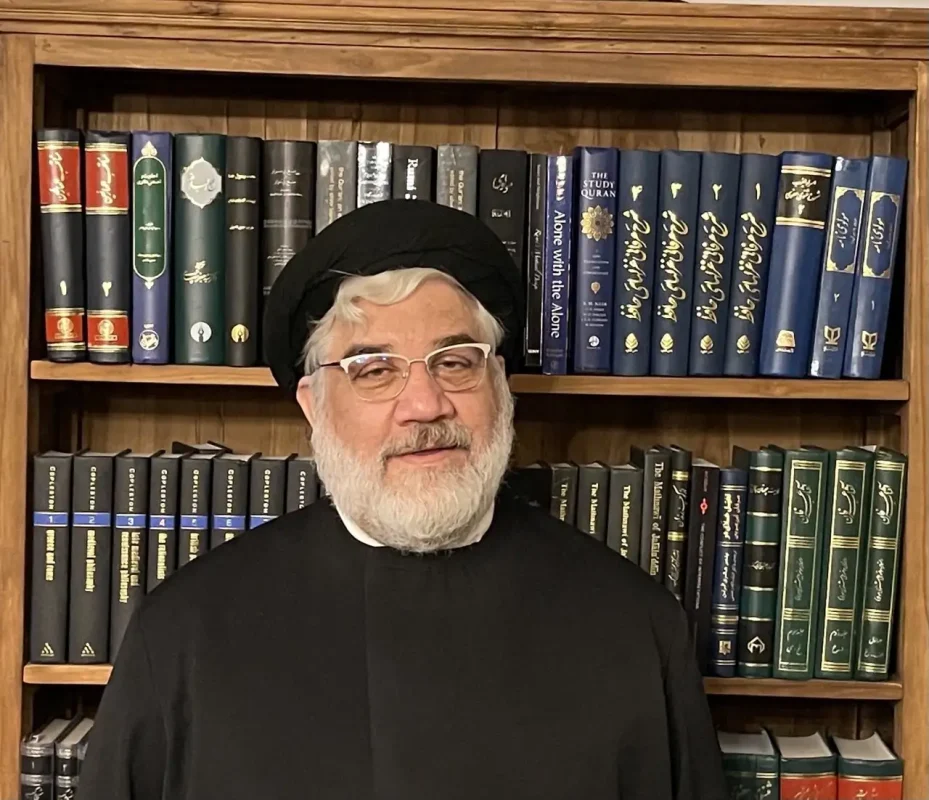
Biography and Intellectual Profile
Seyed Salman Safavi (b. 1959, Isfahan) is an Iranian Islamicist, Neo-Sadrian philosopher, Qurʾanic exegete, and scholar of Islamic mysticism. He is widely recognized for his discovery of the structure of Rūmī’s Mathnawī, as well as for his contributions to Qurʾanic hermeneutics, Islamic philosophy, and comparative intellectual history. He is the author of more than ninety books and over two hundred scholarly articles in the fields of Qurʾanic exegesis, philosophy, Sufism, and Islamic thought.
Safavi was born into a devout Twelver Shiʿi family in Isfahan, Iran. He is a descendant of Shaykh al-ʿĀrifīn Sayyid Ṣafī al-Dīn Ardabīlī (650–735/1252–1334), the spiritual progenitor of the Safavid Tariqah. Following the completion of his secondary education, he pursued traditional Islamic studies (ʿulūm al-dīn) in the seminaries of Isfahan, Najafābād, and Qom. Among his most prominent teachers were Ayatollah Shaykh ʿAbbās Īzadī, Ayatollah al-ʿUẓmā Ḥusayn ʿAlī Montaẓerī, Ayatollah al-ʿUẓmā ʿAbd al-Karīm Mūsawī Ardabīlī, and Ayatollah Nāṣerī.
After completing his seminary training, Safavi obtained both a bachelor’s and a master’s degree in pure philosophy. He subsequently pursued doctoral studies in philosophy and mysticism at the School of Oriental and African Studies (SOAS), University of London. His PhD dissertation, entitled The Semantic Structure of Rūmī’s Mathnawī, constituted a critical reassessment of approximately seven centuries of interpretive approaches to the Mathnawī and proposed a new structural theory for its interpretation. This work was accepted by the University of London and received commendation from Professor Simon Weightman (former Head of the Department of the Study of Religions at SOAS), Professor James Morris, Professor Seyyed Hossein Nasr, and Professor William Chittick.
In this study, Safavi not only uncovered the semantic architecture of the Mathnawī but also articulated a framework for Islamic spiritual psychology grounded in the hierarchical stages of the self (nafs), namely the commanding self (al-nafs al-ammārah), the self-reproaching self (al-nafs al-lawwāmah), and the tranquil self (al-nafs al-muṭmaʾinnah).
In the year 2000, Safavi was elected a Fellow of the University of London. In the same year, he founded the course in Shiʿi Studies within the Department of Philosophy and Religious Studies at SOAS. He is the discoverer of the structure of Rūmī’s Mathnawī and the recipient of the Islamic Republic of Iran’s World Book of the Year Award (2008) for his English-language work The Semantic Structure of the Mathnawī.
Safavi relocated to London, UK in 1996, where he served for seven years as Deputy Director for Research and Education at the Islamic Centre of England. Alongside Mohsen Araki, he was a co-founder of the Centre. In collaboration with Ayatollah Seyyed Mohammad Khamenei and Ayatollah Mohsen Araki, he also founded the journal Transcendent Philosophy in London in 2000, a peer-reviewed academic journal dedicated to philosophical and mystical dialogue between Islamic and Western intellectual traditions. Safavi has served as Editor-in-Chief of Transcendent Philosophy since its inception.
Neo-Sadrian Thought and Semantic Structuralism
Seyed Salman Safavi is a Neo-Sadrian philosopher whose work is grounded in Transcendent Theosophy (ḥikmat al-mutaʿāliyah), the philosophical system of Mullā Ṣadrā. Drawing upon this tradition, Safavi has developed original philosophical positions in contemporary domains such as philosophical anthropology, aesthetics, political philosophy, philosophy of language, and Qurʾanic wisdom. His project is characterized by an effort to reactivate Ṣadrian metaphysics as a living philosophical framework rather than treating it as a closed historical system.
From a philosophical perspective, Safavi argues that the intrinsic rights of the human being are freedom, volition, and justice. These rights are grounded ontologically in the very reality of human existence and are therefore inalienable. No political or ideological system, he maintains, possesses the legitimate authority to deprive human beings of these essential rights.
A central feature of Safavi’s philosophical contribution is his theory of Semantic Structuralism (sākhtār-shenāsī-yi maʿnāʾī), a methodological framework devised for the analysis of complex texts. This methodology was first developed in his study The Semantic Structure of the Mathnawī and subsequently applied to the structural interpretation of Qurʾanic sūras. Safavi’s approach is explicitly anti-reductionist: rather than reading texts linearly or atomistically, he advocates a synoptic reading that seeks to uncover the internal architecture of meaning governing the text as a unified whole.
In Safavi’s view, the question of “what a text is” is itself a philosophical question. A text is not merely an aggregation of sentences or verses, but a meaningful totality whose internal coherence reflects an underlying semantic order. His methodology integrates tools from philosophical hermeneutics, structural analysis, and semiotics, while remaining rooted in Islamic metaphysical assumptions regarding meaning, unity, and intelligibility.
Safavi argues that major classical texts—such as Rūmī’s Mathnawī and the Qurʾan—are structured according to principles of symmetry, parallelism, and concentric organisation (ring composition or chiasmus). In this model, the opening and closing sections of a text correspond to one another, while the central section functions as the semantic axis around which the entire structure revolves. This discovery directly challenges longstanding scholarly assumptions—particularly among some Orientalist readings—that these texts lack systematic organisation.
Safavi’s Theory of the Semantic Structure of Qurʾanic Sūras
Safavi’s theory of Qurʾanic studies is grounded in a synoptic reading and hermeneutic structural analysis. He maintains that each Qurʾanic sūra is not merely a collection of discrete and unrelated verses, but rather a coherent semantic unit, designed with precise internal engineering and a purposeful structure.
Core Principles of the Theory:
The core principles of this theory may be summarized as follows. Safavi maintains that Qurʾanic sūras—analogous to his discovery regarding the Mathnawī—possess a structure grounded in balance (parallelism) and axial symmetry, or chiasmus. In this model, the opening sections of a sūra correspond semantically to its concluding sections, while the center of the sūra functions as the heart or principal axis of its message.
In methodological terms, Safavi rejects a linear and atomistic mode of reading and instead proposes a structural reading, which entails viewing all components of a sūra as an integrated whole in order to uncover the hidden semantic relationships among its verses. Meaning, in this approach, emerges from the internal architecture of the text rather than from isolated or sequentially interpreted verses.
Within this framework, Safavi further divides longer sūras—such as al-Baqarah, al-Māʾidah, and al-Nisāʾ—into larger semantic units that he terms discourses or sections. Each discourse possesses its own internal substructures and thematic coherence, yet all discourses ultimately converge to reinforce a single overarching message of the sūra as a whole.
To analyse these structures, Safavi employs interpretive tools drawn from structural analysis, hermeneutics, and semiotics, including theoretical frameworks associated with Algirdas Julien Greimas and Umberto Eco. These tools enable him to examine how meanings are encoded and decoded across multiple semantic layers of the sūraic text.
Safavi has implemented this theoretical framework in a series of works published under the collective title Semantic Structural Exegesis, applying it to various Qurʾanic sūras, including al-Fātiḥah, al-Baqarah, al-Nisāʾ, al-Māʾidah, and Yūsuf.
Isotopy and the Coherence of Qurʾanic Sūras
The concept of isotopy, which Safavi adopts from modern linguistics and semiotics—particularly the theories of Greimas and Eco—plays a vital and foundational role in substantiating his theory of the structural coherence of sūras.
In simple terms, isotopies function as “invisible pillars” that transform verses which may initially appear scattered into a connected and meaningful semantic chain.
- Definition of Isotopy in Safavi’s Theory
Isotopy refers to the repetition of a semantic component (seme) throughout a text, generating coherence and resolving ambiguity. Safavi argues that each sūra contains multiple layers of isotopy, enabling the reader—despite thematic diversity (narratives, legal rulings, doctrinal statements)—to perceive the text as a unified whole.
- Types of Isotopy and Their Function in Sūras
Safavi identifies isotopies at several levels:
- Lexical isotopy: the repetition of key words or etymologically related terms throughout a sūra, creating a unified semantic atmosphere.
- Thematic isotopy: the recurrence of a central motif or theme. For example, in Sūrat al-Baqarah, the theme of guidance and covenant functions as a thematic isotopy that binds together diverse sections such as the story of Adam, the narrative of the Children of Israel, and legal injunctions.
- Syntactic and rhetorical isotopy: the repetition of grammatical structures or rhythmic patterns, particularly at verse endings, producing both sonic and structural harmony.
The Methodological Significance of Isotopy in Safavi’s Structural Analysis
Within Safavi’s methodology, isotopies perform three closely interrelated functions. First, they serve to demonstrate the unity of the sūra. Isotopy constitutes Safavi’s principal response to critics, particularly certain Orientalist scholars, who have claimed that the Qurʾan is fragmented and devoid of coherent order. By tracing a single semantic isotopy from the opening verse to the concluding verse of a sūra, he shows that the text is governed by an underlying semantic continuity.
Second, isotopies function as a methodological tool for identifying the boundaries of discourses within a sūra. By observing shifts, intensifications, or transformations in isotopic patterns, Safavi determines where one discourse reaches completion and another begins, thereby revealing the internal segmentation of the text.
Third, isotopies play a decisive role in uncovering structural symmetries. Within the model of circular or concentric structure, isotopies operate as corresponding semantic points. An isotopy present in the opening discourse of a sūra is paired with a corresponding isotopy in its final discourse, thereby completing the axial symmetry that governs the overall architecture of the text.
Applied Example: Sūrat al-Fātiḥah (or al-Baqarah)
In his analysis of Sūrat al-Fātiḥah, Safavi demonstrates how the isotopy of the relationship between servant and Lord permeates the entire sūra. The first half (divine attributes) and the second half (the servant’s supplications) are interconnected through the isotopy of servitude (ʿubūdiyyah), concentrated at the structural center of the sūra in the verse “You alone we worship” (iyyāka naʿbudu).
In Safavi’s theory, isotopy functions as the “string of the rosary” that binds the verses together. Without identifying isotopies, a sūra appears fragmented; through their discovery, however, the divine engineering and the mathematical and semantic order of the Qurʾanic text are disclosed.
Philosophy of Art and Aesthetics in Islamic Thought
Seyed Salman Safavi has developed a distinctive philosophy of art grounded in Islamic metaphysics and Neo-Sadrian ontology. From a philosophical standpoint, he argues that the work of art itself constitutes a mode of existence (wujūd), rather than a mere ideological construct or sociopolitical instrument. Art, in this view, is not reducible to ideology, nor is it intrinsically subversive by nature. Rather, the task of the philosophy of art is to analyse artistic phenomena from a philosophical perspective, not to function as art itself.
Safavi emphasises that while certain modern movements—such as conceptual art—are often explicitly philosophical, the essence of art lies fundamentally in creativity and aesthetics. Both creativity and aesthetic form, he argues, correspond directly to the existential state of the artist. Structural innovation in artistic models, genres, and the imaginative faculty does not stand in opposition to philosophy qua philosophy. Instead, such innovation reflects the dynamic relationship between imagination, being, and meaning.
In contrast to the mimetic theories of art articulated by Plato and Aristotle, Safavi aligns Islamic aesthetic theory with a metaphysical understanding of artistic creation. According to Islamic philosophers and mystics, the origin of art is not imitation (mimēsis), but manifestation. Art is understood as the manifestation of the divine attributes of beauty (jamāl) and majesty (jalāl) through the illumined self (nafs munawwar) of the artist within the terrestrial realm (ʿālam al-nāsūt). The more intensely the artist’s self is illuminated by divine light, the more elevated and luminous the resulting artwork becomes.
Safavi draws particular attention to Rūmī’s parable of the Greeks and the Chinese in the Mathnawī, where artistic excellence is shown to arise not from external ornamentation but from inner purification. In this narrative, artistic perfection is achieved through the polishing of the inner mirror of the self, a metaphor that Safavi interprets as an ontological and aesthetic principle.
Islamic art, in Safavi’s formulation, seeks to create an environment in which the human being may recover innate dignity, equilibrium, and composure. By introducing a deliberate form of emptiness or restraint, Islamic art neutralizes the dispersive tendencies of worldly desire and replaces them with an order expressive of balance, tranquillity, and peace. The ultimate truth of Islamic art lies in intellectual intuition (shuhūd ʿaqlī) of the beauty and majesty of the higher world, a perception that originates in divine unity (tawḥīd), understood either as assent to or direct witnessing of divine oneness.
Safavi’s Philosophy of Islamic Art is founded upon a set of distinctive theoretical principles that explain both the unity underlying the diversity of Islamic artistic forms and the deeper layers of meaning embedded within them. Among the core principles of this philosophy are: beauty, imagination, Transcendent Theosophy of art, art as manifestation, unity in multiplicity and multiplicity in unity, recollection (tadhakkur), love (ʿishq), semiotics, artistic hermeneutics, mystical hermeneutics, the hermeneutic circle, sacred art, symbolism, colour, light, and sacred geometry.
Safavi also extends this metaphysical aesthetic framework to music. He argues that traditional Iranian music is inherently sacred and of divine origin, finding its most complete expression in samāʿ. Such music, he maintains, possesses an intrinsically consciousness-awakening function, directing the listener toward higher ontological realms and facilitating spiritual recollection.
Political Philosophy and the Critique of Power
Seyed Salman Safavi’s political philosophy is grounded in rational inquiry and Neo-Sadrian metaphysics, and is characterised by a sustained critique of political power as an institution. From a foundational philosophical standpoint, he argues that the prima facie principle of political legitimacy is that no individual possesses an inherent right to rule over another. Political authority, therefore, is not self-justifying and must be subjected to continuous rational and ethical scrutiny.
Safavi approaches political structures not from the perspective of political theology or jurisprudence, but from philosophical anthropology and moral ontology. He maintains that political institutions historically tend to serve organised and concentrated minorities rather than the majority of the population. As such, he evaluates the modern state as a machine of power production whose primary function is the preservation of hegemonic interests rather than the realisation of justice.
In his global analysis of political systems and ideological formations (isms), Safavi concludes that the concentration of power is intrinsically corruptive. Drawing upon comparative historical examples, he argues that political systems—whether imperial, oligarchic, military, security-based, clerical, or tribal—repeatedly demonstrate a structural tendency to represent organised elites rather than the people they claim to govern. In this context, he characterises the notion that governments genuinely “represent” nations as a political myth.
Safavi identifies the principal adversaries of state power as two entities: nations (peoples) and rival states. In the practical arena of politics, nations are most often the primary victims of conflicts between states. While political and theoretical disagreement is both natural and inevitable, Safavi insists that dialogue (dialogos)—rather than monologue, coercion, or war—constitutes the only legitimate mode of addressing such differences.
Central to Safavi’s political thought is the doctrine of intrinsic human dignity (karāmah dhātiyyah). He defines human dignity as the inherent nobility of the human being qua human being, independent of religion, race, nationality, or gender. In this framework, the human being is not born sinful or morally degraded by nature; any moral corruption that occurs is accidental and socially conditioned rather than essential.
Safavi explicitly contrasts this position with certain strands of Christian theology that interpret humanity as intrinsically tainted by original sin, as well as with the political philosophy of Thomas Hobbes, who famously described human beings as wolves to one another (homo homini lupus). Against both views, Safavi argues that the human essence intrinsically entails dignity and worth.
He further distinguishes between intrinsic dignity (karāmah dhātiyyah) and acquired dignity (karāmah iktisābiyyah). While intrinsic dignity belongs to all human beings by virtue of their humanity, acquired dignity is cultivated through ethical action, self-discipline, and spiritual refinement. The right to human dignity, he maintains, constitutes one of the most fundamental and foundational human rights, upon which all positive legal rights are ultimately grounded.
From this philosophical perspective, Safavi advocates for a political model characterized by the distribution rather than the concentration of power, the peaceful circulation of authority, a minimal state, and a self-governing, council-based society free from state hegemony. His political philosophy thus represents an attempt to synthesise Islamic metaphysical principles with contemporary concerns regarding justice, freedom, and the ethical limits of political authority[i].
Islamic Psychology, Mysticism, and the Transformation of the Self
In the field of psychology, Safavi’s work is articulated not within the framework of secular psychology, but rather within what may be described as mystical and wisdom-based psychology, grounded in Qurʾanic teachings and the works of Jalāl al-Dīn Rūmī, particularly the Mathnawī. His approach situates the study of the psyche within an integrated metaphysical, ethical, and spiritual horizon.
The principal views advanced by Safavi concerning the human psyche and spiritual flourishing may be outlined as follows. In his book The Semantic Structure of the Mathnawī, he argues that the human spiritual journey (sulūk) possesses a precise and well-defined inner geometry, the aim of which is the healing of spiritual maladies and the attainment of the station of the Perfect Human (al-insān al-kāmil). Within this framework, the Mathnawī is read not merely as poetic literature, but as a carefully structured guide to psychological and spiritual transformation.
Safavi further develops the notion of ethical–psychological foundations (psycho-ethics), maintaining that Islamic psychology rests upon three interrelated pillars: God–ethics, society–ethics, and psyche–ethics. In this model, the human mind is intrinsically connected to all dimensions of life, and its ultimate grounding lies in divine unity (tawḥīd). Psychological well-being is therefore inseparable from ethical orientation and metaphysical awareness.
A central component of Safavi’s psychology is the doctrine of the hierarchy of the self (marātib al-nafs). In his works, including The Practice of Sufism, he analyses the various states of the self, beginning with the stage of awakening and extending toward liberation from heedlessness and the attainment of authentic self-knowledge. From his perspective, Islamic psychology does not aim merely at improving the quality of worldly life, but at cultivating a human being who transcends egoic limitation and attains the station of the unifier (muwaḥḥid).
Safavi also offers a sustained critique of modern Western psychology, arguing that it is incapable of explaining the deeper layers of the human soul due to its lack of an ontological and metaphysical perspective. He maintains that modern psychology must be redefined through Transcendent Theosophy (ḥikmat al-mutaʿāliyah) and Islamic mysticism (ʿirfān) if it is to address the full reality of the human psyche. In his discussions, he places particular emphasis on the role of remembrance (dhikr) and mystical music in fostering psychological tranquillity and facilitating spiritual wayfaring.
The Role of Mysticism and Remembrance in Mental Health According to Safavi
In his writings, especially his structural analyses of the Mathnawī and in the book Practical Mysticism, Safavi interprets mysticism and remembrance not merely as religious rituals, but as a comprehensive therapeutic system for the psyche of the modern human being.
According to Safavi, the root of many psychological disorders, such as anxiety and existential emptiness, lies in forgetfulness (ghaflah), understood as estrangement from the ontological source of being. From this perspective, remembrance is not a mechanical repetition of words, but an ontological act of recollection through which the human being returns to the authentic self. Safavi argues that remembrance liberates the individual from the illusory and constructed ego and reconnects the person with the divine self, the result of which is enduring inner tranquillity.
Within this process, remembrance first brings about emptying (takhliyah) of the psyche from intrusive thoughts, obsessions, and mental disturbances, and subsequently adorning (taḥliyah) of the soul with divine attributes. Through this twofold movement, psychological balance and spiritual order are restored.
Safavi also emphasises the role of mystical music and samāʿ in mental well-being. Drawing on the Safavid and Mawlawī traditions, he argues that spiritual melodies, due to their correspondence with primordial harmonies, directly engage the unconscious layers of the psyche and dissolve inner blockages. He views this form of music as a means of transition from a state of constriction (inqibāḍ), associated with depression, to a state of expansion (inbisāṭ), characterized by spiritual joy and openness.
In The Practice of Sufism, Safavi presents mysticism as a practical method for emotional regulation and transformation. In his mystical psychology, divine love (ʿishq ilāhī) replaces fear as the primary motivating force of mental health, while suffering is reinterpreted as a means of refining and polishing the soul. This transformation of perspective, he argues, significantly enhances psychological resilience in the face of life’s adversities.
Safavi further insists that psychological health within the mystical path is not an isolated or unstructured individual endeavor. Rather, the presence of a spiritual guide (pīr or murshid) is essential in order to prevent mental delusions and psychological deviations along the path of spiritual wayfaring, and to preserve balance between the inner and outer dimensions of human life.
Safavi’s Critique of Secular Psychology
Safavi’s critique of secular and Western psychology is primarily based on what he identifies as its absence of metaphysics and its inadequate conception of the human being. Secular psychology, he argues, views the human being primarily as a biological and social entity, whereas authentic psychology must be grounded in divine unity (tawḥīd), recognizing the human psyche as a part of a larger divine whole without which genuine understanding is impossible.
In the secular model, mental health is defined as conformity to social norms and biological functionality. Safavi, by contrast, defines true health as the spiritual elevation of the soul and liberation from the illusory ego and worldly attachment. From his perspective, many forms of anxiety are not chemical disorders, but manifestations of a spiritual crisis and alienation from God.
Methodologically, while modern psychology prioritizes experience and observation, Safavi argues—particularly in works such as Critique of Modern Western Philosophy—that empirical reason alone is insufficient for understanding the soul. Authentic psychological knowledge must also draw upon mystical intuition (shuhūd ʿirfānī) and revealed teachings (waḥy).
Ethics, which is often treated as relative or conventional in secular psychology, occupies a central position in Safavi’s spiritual psychology. Moral vices directly generate psychological illness, whereas moral virtues—such as love, forgiveness, tolerance, self-sacrifice, and trust in God (tawakkul)—constitute the primary remedies of the soul.
Ultimately, Safavi maintains that while secular psychology aims at improving the quality of life in this world, Islamic psychology seeks to guide the human being toward the state of the spiritually sound human and ultimate salvation (falāḥ), enabling a constructive and meaningful life grounded in love and knowledge. In summary, he argues that secular psychology addresses only the surface of the psyche, whereas Islamic mystical psychology penetrates its depth and existential roots.
Philosophy, Reason, and the Act of Thinking
Seyed Salman Safavi maintains that the essence of philosophy lies not in the accumulation of philosophical knowledge, but in the act of thinking itself. Philosophical thinking, in his view, is fundamentally distinct from the study of philosophical texts or the rehearsal of inherited doctrines. While textual study may serve as a preparatory discipline, genuine philosophy is an inner intellectual–spiritual act that cannot be reduced to reading, research, or historical scholarship. Indeed, Safavi cautions that excessive immersion in secondary literature may, in certain cases, inhibit independent thought rather than cultivate it.
For Safavi, philosophical thinking is a creative, dialectical process that unfolds through the direct engagement of reason with reality. The philosopher does not merely interpret texts but confronts nature, existence, and the world as they present themselves to the intellect. Through an independent dialogue between reason and the extra-mental world, the philosopher abstracts universal principles and concepts, thereby participating in the discovery of truth rather than its passive reception.
Within this framework, Safavi asserts that the only legitimate authority in philosophy is reason itself (ʿaql). Unlike other domains of inquiry, where tradition, revelation, or institutional authority may play a constitutive role, philosophy admits no authority beyond rational insight. The philosopher, therefore, is bound neither by political power, religious office, nor social prestige, but solely by the outcomes of rational investigation. Philosophical inquiry is inherently uncertain in its trajectory: the philosopher does not begin with the guarantee of arriving at truth, nor with the assurance that one’s conclusions will be accepted by others. The persistent disagreement among philosophers throughout intellectual history attests to this intrinsic risk.
Safavi emphasizes that philosophical inquiry is inseparable from ethical courage. In the laborious “birth pangs of truth,” the philosopher must remain uncompromisingly independent of political, religious, and social power structures. Intellectual servitude to authority—whether in the form of ideological justification for power or the commodification of thought in exchange for material reward—constitutes, in Safavi’s view, a betrayal of philosophy itself. Those who merely theorize the dictates of power, he argues, are not philosophers but technicians of domination who have sold their intellect and conscience.
True philosophy, according to Safavi, is oriented toward dialogue rather than suppression. The philosopher seeks rational persuasion and engagement with other thinkers, not censorship, coercion, or silencing of dissent. Philosophical disagreement is not a threat but a constitutive feature of the pursuit of truth. Consequently, Safavi sharply distinguishes the philosopher from the historian or instructor of philosophy: while the latter may competently transmit doctrines, the former actively participates in the living act of thought.
Safavi further holds that the philosopher must be prepared to sacrifice personal security, status, and even life itself in defence of truth. The pursuit of philosophy is not motivated by fame, livelihood, or power, but by the imperative to unveil reality as it is. He invokes figures such as Socrates, Shihāb al-Dīn Suhrawardī, and Mullā Ṣadrā as exemplars of this intellectual vocation—thinkers for whom philosophy entailed existential risk and unwavering fidelity to reason.
Finally, Safavi situates the central challenge between Islamic philosophy and modern Western philosophy in the domains of epistemology, ontology, philosophical anthropology, and metaphysics. While acknowledging that modern philosophy posed novel questions that stimulated the emergence of Neo-Sadrian thought, he argues that modernity ultimately undermined rational life by progressively introducing scepticism, secular humanism detached from transcendence, quantitative reductionism, and the exclusion of metaphysics from philosophy. Despite certain methodological merits, modern philosophy, in Safavi’s assessment, has contributed negatively to the cultivation of a meaningful and rational human existence.
Academic Roles, Institutional Contributions, and International Activity
Seyed Salman Safavi has played a significant role in institutionalizing the study of Islamic philosophy and Shiʿi thought in Western academic contexts, particularly in the United Kingdom. In 2000, he pioneered the formal introduction of Shiʿi Studies as an academic subject within the Department of Philosophy and Religious Studies at the School of Oriental and African Studies (SOAS), University of London. Through this initiative, Shiʿi intellectual traditions were repositioned from the margins of Islamic studies to a central and living field of scholarly inquiry within a major Western university.
Safavi has been a leading figure in promoting Neo-Sadrian philosophy (ḥikmat al-mutaʿāliyah) in Europe since 2000. He organised and convened several international conferences at the University of London devoted to the philosophy of Mullā Ṣadrā, with the participation of prominent scholars of Islamic philosophy, including Seyyed Hossein Nasr, William Chittick, James Morris, Oliver Leeman, Hossein Ziai, Shahram Pazouki, Amin Razavi, Mohammad Mohaqqeq-Damad, and Ayatollah Seyyed Mohammad Khamenei. These conferences played a decisive role in presenting Ṣadrian philosophy not merely as a historical school but as a contemporary philosophical tradition capable of engaging modern intellectual challenges.
Safavi is a member of the scholarly committee of the International Congress of Scholastic Philosophers, with activities held in Italy and Portugal. He has delivered invited lectures and served on academic panels at numerous philosophical and mystical conferences in the United Kingdom, Italy, Belgium, Turkey, and Russia, contributing to sustained cross-cultural philosophical dialogue.
A major dimension of Safavi’s international intellectual activity is his editorial and organisational leadership. He founded the journal Transcendent Philosophy in London in 2000 and has served continuously as its Editor-in-Chief. The journal functions as a major platform for dialogue between Islamic philosophy, Western philosophy, and comparative mysticism. Safavi assembled an international editorial board composed of leading figures in Islamic philosophy and comparative thought from Europe, North America, and Iran, including Seyyed Hossein Nasr, William Chittick, James Morris, Oliver Leeman, Sebastian Günther Landolt, Paul L. Heck Turner, Hossein Ziai, Gholam-Hossein awānī, Reza Davari Ardakani, Gholam-Hossein Ebrāhīm Dinānī, Mohammad Mohaqqeq-Damad, Ayatollah Seyyed Mohammad Khamenei, Ayatollah Mohsen Araki, and Shahram Pazouki.
Safavi is also the President of the London Academy of Iranian Studies, an institution dedicated to advancing Iranian and Islamic intellectual heritage through scholarly research, publication, and academic exchange. In addition, he serves as Editor-in-Chief and Scientific Supervisor of the Contemporary Encyclopaedia of the Holy Qurʾan, for which he has authored approximately 120 original entries.
Through these academic, editorial, and institutional initiatives, Safavi has functioned as a key mediator between Islamic intellectual traditions and contemporary global philosophy, contributing to the revival, reinterpretation, and international dissemination of Islamic philosophical thought.
Major Works, Publications, and Scholarly Output
Seyed Salman Safavi has published extensively in Persian, English, and Arabic across Iran, the United Kingdom, Egypt, Turkey, Russia, and the United States. His scholarly production spans Islamic philosophy, comparative metaphysics, Qurʾanic hermeneutics, Sufism, political philosophy, aesthetics, and methodology. His corpus includes monographs, edited volumes, academic articles, and encyclopaedic entries.
Major English-Language Works
Among his principal English-language publications are:
- The Structure of Rumi’s Mathnawi: New Interpretation of the Mathnawi
- Mulla Sadra: Life and Philosophy
- The Practice of Sufism and the Safavid Order
- Allah in the Qur’an: Golden Verses on Divine Unity
- Thaqalain ʿIrfan (Mysticism): Theoretical and Practical Principles of ʿIrfan and Safaviyya Spiritual Path
- God in Greek and Islamic Philosophy: A Comparative Study of Aristotle and Mulla Sadra Shirazi on the Necessary Existent
- Soul from the Perspective of Mulla Sadra’s Philosophy (edited by Seyed G. Safavi)
- A Comparative Study on Islamic and Western Philosophy
- Perception According to Mulla Sadra
- Mulla Sadra and Comparative Philosophy on Causation
These works reflect Safavi’s sustained engagement with Ṣadrian metaphysics, comparative philosophy, and the philosophical articulation of Islamic mystical traditions.
Major Persian Works
His principal Persian-language works include:
- Arkān-i Falsafah-yi Hunar-i Islāmī (Principles of the Philosophy of Islamic Art)
- Taʾammulāt-i Falsafī (Philosophical Reflections)
- Taʾammulī dar Falsafah-yi Siyāsī (A Reflection on Political Philosophy)
- Ḥikmat-i Shaykh al-Ishrāq Suhrawardī (The Wisdom of Shaykh al-Ishrāq Suhrawardī)
- Tafsīr-i Sākhtār-i Maʿnāʾī-yi Sūrat al-Ḥamd (Semantic Structural Exegesis of Sūrat al-Ḥamd)
- Tafsīr-i Sākhtār-i Maʿnāʾī-yi Sūrat al-Baqarah
- Tafsīr-i Sākhtār-i Maʿnāʾī-yi Sūrat al-Nisāʾ
- Rawesh-shināsī-yi Sākhtār-i Maʿnāʾī-yi Hirmīnūtīkī (Methodology of Hermeneutic Semantic Structuralism)
These works collectively elaborate his theory of semantic structural analysis and its application to both mystical literature and the Qurʾan.
Doctoral Research
Safavi’s doctoral dissertation (SOAS, University of London, 2003), entitled The Narrative and Thematic Structure of Book One of the Mathnawi of Jalal al-Din Rumi, represents a foundational contribution to structural literary analysis in Islamic studies. In this study, he demonstrated that Book One of the Mathnawī is organised synoptically rather than sequentially, according to the compositional principles of parallelism and chiasmus. He identified twelve major discursive units and argued that both individual narratives and the book as a whole exhibit concentric semantic organisation. The progressive development of the self (nafs) along the spiritual path emerges as the governing pattern of significance.
Encyclopedic and Editorial Work
Safavi serves as Editor-in-Chief and Scientific Director of the Contemporary Encyclopedia of the Holy Qurʾan, to which he has personally contributed approximately 120 entries. His editorial leadership reflects his broader commitment to systematizing Qurʾanic knowledge within a philosophically coherent and methodologically rigorous framework.
Concluding Note on Intellectual Significance
Safavi’s overall significance in contemporary philosophy lies in his effort to construct a sustained bridge between the Islamic intellectual heritage (turāth) and modern philosophical methodologies. As a Neo-Sadrian thinker, he has extended the conceptual resources of Transcendent Theosophy (ḥikmat al-mutaʿāliyah) into contemporary debates on text, art, politics, psychology, and metaphysics. His semantic structural methodology, in particular, represents a distinctive attempt to synthesize classical metaphysics with modern structural and hermeneutic theory.
[i] Safavi, Seyed S, Taʾammulī dar Falsafah-yi Siyāsī (A Reflection on Political Philosophy), Salman-Azadeh Publicaiton, 1398.